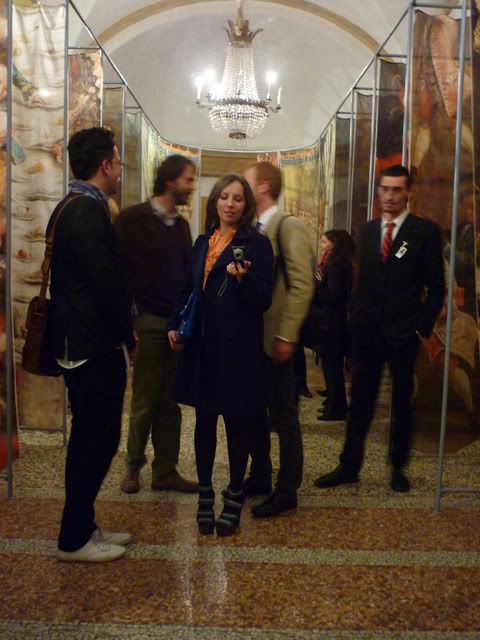
All photos © Phoebe English
Monday, 26 March 2012
Phoebe English
All photos © Phoebe English
Wednesday, 26 January 2011
Fashion crush: Martina Austin Spetlova and Thomas Tait
Martina Austin Spetlova
Memory is a funny, fickle thing. During LFW, you see so much, so often that it becomes difficult to remember what you saw where and who designed it. Especially at the student shows where twenty odd graduates each present a capsule collection, even the most wildly divergent styles tend to meld into one.
Shao-Yen Chen
Monday, 22 February 2010
London Fashion Week round-up (Days 1 and 2)
So fashion week kicked off on Friday and if you follow me on Twitter, you'll have noticed that I've been out and about going fashion crazy. Apologies to Twitter friends (and real life friends) who have no interest in fashion. I promise it will be all over soon.
After Koma, I went upstairs to the BodyAMR presentation. I've been a fan of this label since I picked up one of his dresses last year - a gorgeous, hooded, black chiffon dream. I'm not crazy about everything produced under the BodyAMR label, but there are some absolute knockouts. This collection was all desert-dwelling space-age princess clothes and the venue was awesome - upstairs in the Freemason's Hall - the models going through these stunningly intricate carved gates to get to the press pack at the end of the runway. The models all looked incredible - in fact most of the models I've seen this year have looked great - really healthy and glowing. A nice change from some years...
The funniest thing was that I was sitting behind this girl with a really cute hat on. I snapped a cheeky pic and two seconds later the papps went haywire. Turned out she was Olivia Inge - mega famous model. She seemed pretty good-humoured when we admitted we had no idea who she was. Nice girl.
Olivia Inge at BodyAMR
Saturday
tribute wall to McQueen inside the main BFC tent
so much queuing!
photo from Dazed Digital
final walk at Emilio
bloggers area in the main tent
photo from HollyFulton.com
I also really loved the outerwear by Christopher Raeburn, a British designer who makes beautiful coats and bomber jackets out of recycled military uniforms and parachutes. Such an imaginative and inventive way to reuse military surplus and as a big plus, the lady watching over the stand was super nice.
menswear jackets at Christopher Raeburn
above and below photos from Christopher Raeburn blog

photos by Marcio Madeira/FirstView.com at Style.com
messing about being 'fashion-y'
waiting inside the tent
Note: all photos are my own unless otherwise noted.
Thursday, 5 March 2009
LFW - The Buildings Behind the Brands

(Article published in the AJ 05.03.09)
The venues build the clothing brands as much as the models at London Fashion Week, writes Crystal Bennes
London Fashion Week, 20-25 February, various venues, London
London Fashion Week (LFW) celebrates its 25th anniversary this year, and while you may think that there’s not much of a connection between LFW and London’s architecture, you’d be mistaken. Catwalk shows in venues like the Royal Opera House, a carpark in Brewer Street and the Korean Embassy are a crucial part of the designers’ managing of their brands.
Since 2006, the home of LFW has been the Natural History Museum in Kensington, where the British Fashion Council (BFC) – the body that promotes British fashion designers – has its tent. While the white tents of LFW have not become as iconic as those of New York Fashion Week in Bryant Park, for fashion-forward Londoners they represent the glamorous lifestyle associated with the capital’s fashion industry.
Though designers don’t like to admit it, the recession has had an impact on the excesses of fashion week. This year saw only one tent on the lawns of the museum, as more and more designers are taking their pick of London’s buildings for use as runway stages. Showing outside of the BFC tent is not only more cost effective, it also allows the designer to appropriate a building to extend its brand image in a way not possible in the one-size-fits-all BFC tent.
Take two very different brands: Nicole Farhi and PPQ. Farhi has been in business for 27 years and is one of Britain’s most established designers. Her clothes are refined but playful, with an emphasis on tailoring in beautiful fabrics. PPQ on the other hand describe their look as ‘luxe pop-chic and underground London cool’ and are favoured by indie-pop stars. Neither brands showed at the BFC tent. Instead, Farhi showed at Edward Middleton Barry’s Royal Opera House, in the glass-domed Floral Hall (1860), and PPQ showed in the Samuel Ware-designed Burlington Arcade (1819).
Not only does the architectural stage serve as the backdrop for the runway spectacle, but the constraints of the space also dictate the fashion world’s strict hierarchy. At Farhi, the catwalk was arranged in a square, instead of the traditional long rectangle, with the biggest names in the fashion press on one side, buyers across from them, lesser press on the third side, with VIPs in the front row, on display as much as the models. PPQ’s venue provided its own constraints, both to the staging but also to the all-important industry hierarchy, when nearly everyone became front-row, given the arcade’s confined space.
The Farhi-Opera House partnership is a good fit as both brands identify with refinement, luxury and sophistication; it clearly works for Farhi, as she has shown there for the past four years.
PPQ-Burlington Arcade, however, is a marriage of practicality. After closing their Conduit Street store last year, the company will soon open a pop-up shop in the Burlington Arcade. While Amy Molyneaux, one of PPQ’s designers, said that a pop-up shop would allow more versatility than the fixed layout of their previous store, certainly a short-term lease in the Burlington Arcade is also less financially demanding than a four-storey Mayfair boutique.
To show or not to show: a question fashion designers may soon be asking themselves in these economically uncertain times – especially when a single catwalk show can cost up to £600,000. If these grand spaces are invisible in the catwalk snaps published in fashion magazines worldwide, why go to the trouble and expense of a major show? Buyers and editors could just as easily look at the collections online. This season, British designer Alice Temperley eschewed a costly runway show in favour of showing her latest collection via a digital installation at her shop, for example.
The numerous considerations involved in producing a show means that the decision to stage must be more about brand management than ease of use. As any fashion insider will tell you, the point of fashion week and its catwalks is spectacle. The celebrities, the unusual venues, the aura of exclusivity: if nothing else, these lavish circuses sell perfume to those who can’t afford the clothes but who still want a piece of the lifestyle associated with these fantastic spectacles. Build something grand enough and your building may serve as the backdrop for a future catwalk.
Tuesday, 24 February 2009
but Larkin will never go out of fashion...

'Dockery was junior to you,
Wasn't he?' said the Dean. 'His son's here now.'
Death-suited, visitant, I nod. 'And do
You keep in touch with-' Or remember how
Black-gowned, unbreakfasted, and still half-tight
We used to stand before that desk, to give
'Our version' of 'these incidents last night'?
I try the door of where I used to live:
Locked. The lawn spreads dazzlingly wide.
A known bell chimes. I catch my train, ignored.
Canal and clouds and colleges subside
Slowly from view. But Dockery, good Lord,
Anyone up today must have been born
In '43, when I was twenty-one.
If he was younger, did he get this son
At nineteen, twenty? Was he that withdrawn
High-collared public-schoolboy, sharing rooms
With Cartwright who was killed? Well, it just shows
How much . . . How little . . . Yawning, I suppose
I fell asleep, waking at the fumes
And furnace-glares of Sheffield, where I changed,
And ate an awful pie, and walked along
The platform to its end to see the ranged
Joining and parting lines reflect a strong
Unhindered moon. To have no son, no wife,
No house or land still seemed quite natural.
Only a numbness registered the shock
Of finding out how much had gone of life,
How widely from the others. Dockery, now:
Only nineteen, he must have taken stock
Of what he wanted, and been capable
Of . . . No, that's not the difference: rather, how
Convinced he was he should be added to!
Why did he think adding meant increase?
To me it was dilution. Where do these
Innate assumptions come from? Not from what
We think truest, or most want to do:
Those warp tight-shut, like doors. They're more a style
Our lives bring with them: habit for a while,
Suddenly they harden into all we've got
And how we got it; looked back on, they rear
Like sand-clouds, thick and close, embodying
For Dockery a son, for me nothing,
Nothing with all a son's harsh patronage.
Life is first boredom, then fear.
Whether or not we use it, it goes,
And leaves what something hidden from us chose,
And age, and then the only end of age.
Friday, 20 February 2009
Why fashion people piss me off

The problem is that most fashion companies hire PR wenches to do their bidding, theoretically leaving the "creatives" free to deal with the creative stuff. And I get the whole need to whip up an aura of exclusivity around the brand - I mean would PPQ or Christopher Kane really want people to think their A-list status was slipping by making sure only celbs like Lilly Allen and Peaches Geldof were in attendance at their shows? Um, right... Teeny boppers who idolise Peaches and Lilly and the clothes they wear aren't going to go out and actually buy PPQ - they're going to wait until Primark or Topshop rips the designs and then buy the, for a song.