Wednesday, 18 July 2012

Florence Trust Summer Exhibition 2012

Photobucket

I am wedded and honeymooned; returned from honeymoon and back in London, a city which I am more and more convinced is one of the best there is for living in. It's sometimes difficult to get a handle on just how great London actually is when you're living in it, when you're too close to it. It's like trying to make out the scale of the Shard from standing right underneath it. All you can see of the city is what's right in front of you at that particular instant: tourists stopping to crane their necks at every unusual cornice; perfectly manicured, semi-suburban neighbourhoods in Highbury; the utter lack of an El Salvadorian restaurant.

A common refrain has started to develop among a lot of my friends, which is something along the lines of how much they want to move out of the city and set up a commune-type thing anywhere that isn't London. When I've just come back from Berlin or had a rubbish day or am just in a certain kind of mood, I think that this sounds like an inspired sort of idea. They get broadband in the country, right? I could have horses again and space and peace and quiet and lots of other nice things. But after honeymooning in Bali, which is a little like living in the countryside for two weeks, I honestly just don't think I could hack it. A man who ran one of the resorts we stayed in said he moved to Bali when he realised that he only liked the thought of having city amenities at his fingertips, not the reality, for the reality was that he never took advantage of London living. In spite of all of the things about living in London that really irk me, I'm just not ready to go anywhere. I'm happy to be here, for here is where things are happening my friend. Unless, that is, you are a connoisseur of self-help workshops and rice-based cuisine, and if that's the case I suggest you hurry yourself to Bali.

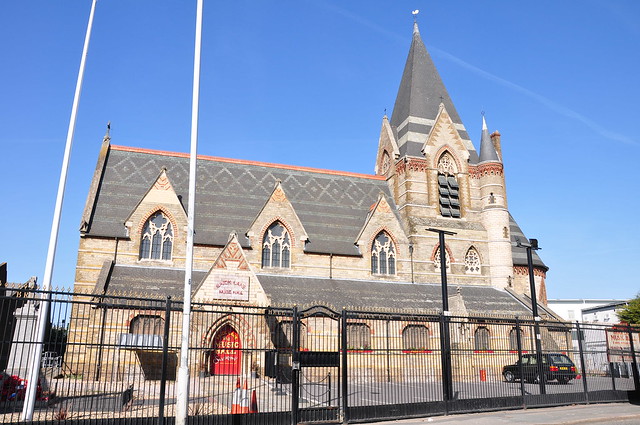
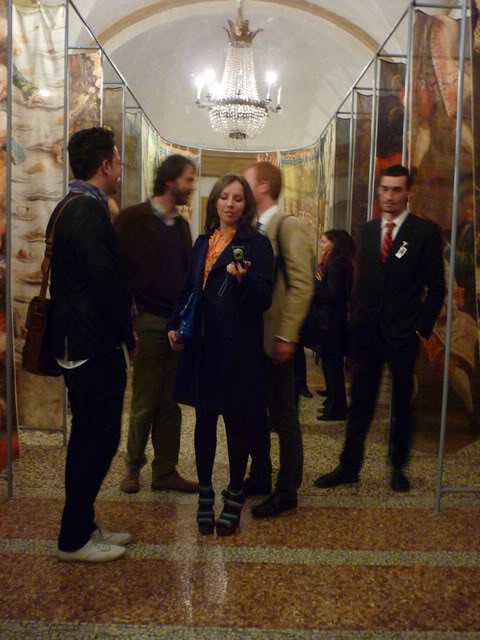
To make up for my two weeks in the desert that is a honeymoon, I went on a massive art binge Thursday last, stopping by a good eight galleries (before capping off the day with some comedy on a roof at Dalston Roof Gardens, courtesy of Spoonfed). Of the lot (Limoncello, Florence Trust, Victoria Miro, Parasol Unit, WW Gallery, Fold, 50 Redchurch St and Studio 1.1), the Florence Trust was by some distance the most interesting show. Not least because the space is amazing (St Saviour's church in Highbury), but also because it was by far the most diverse group of artists and so provided much in the way of mental and aesthetic stimulation.

During the course of the year, the church is sliced up into ten studio spaces for a year-long residency programme which is capped off with an open exhibition. I don't think I'd really heard of the Florence Trust before I knew Ben Woodeson (who is an FT resident this year, and recently strung up an electric fence in the hallway for my most recent show at Flat C - Pink Does Not Exist), whose work primarily triggered my visit to the show. It was interesting to see more ambitious versions of Ben's work previously exhibited elsewhere this year, namely Health & Safety Violation #41 -- some 4,000 matches and a random timer spelling out the phrase "keep in a dry place and away from children". At the discretion of the random timer, the work literally bursts into flames, leaving an almighty burn mark on the wall after the main event. There was also a much larger version of the marble-filled, exploding-balloon sculpture which hung from my bathroom ceiling in the Flat C show. Given that the version in my bathroom hung rather terrifyingly above one's head there was something a little bit neutered about seeing the balloons tacked to a board at eye level, but, with each of them in a various state of destruction and marbles scattered all over the floor of the church, it was still a satisfying piece of work.

PhotobucketPhotobucket
Wandering around trying to find Ben's work, at the west end of the church I walked head first into Corinne Felgate's absolutely massive sculpture, Bigger Than the Both of Us -- an overwhelming number of geometric patterns painted on board swathed in an unholy amount of glitter. Scratching my head, wondering what in the hell was this all about, I looked down to read the plan of works in my hand. When I saw that the subtitle of the work was "Piet Mondrian's complete oeuvre of geometric compositions replicated in glitter" I couldn't help but laugh aloud. I have to say that while the work itself does little for me, I do like a good chuckle. It doesn't happen often enough in art exhibitions.

Nicholas Johnson's acrylic paintings on paper were like looking at crystals under a microscope, but were unfortunately (or maybe not!) more captivating when reproduced in the catalogue than in real life; reading about her works in the catalogue, I felt I could fall in love with the works of Hanae Utamura, but I was disappointed by the confused installation -- an HD video loop of someone running up and down a garret tower in front of a floor strewn with plaster. The catalogue described an artist who attempted to cast the waves of the ocean by pouring wet plaster into the sea. I couldn't see the link between the artist who made such clever, elegiac works with the uninspired video in front of me.

Photobucket
The work of JL Murtaugh was an unexpected treat. A self-described agent provocateur is an artist I nearly always expect to be dreadful, but perhaps it helped that I saw the work before I read the blurb. Though if I'm honest, I'm still not entirely sure what the works actually were. Entitled Psalm for the Solvent Estates (after Booth and Charlemagne), described as a colour-coded economic classification and reconfigured hymn applied to Aberdeen Park and Europe, there were apparently twenty-two parts to the classification/hymn of which five were painted onto various walls around the space. Like a partially-eaten pie chart painted at various points around the room, each was accompanied by a verse from the "reconfigured hymn", e.g. Some almighty power sevenfold rich in energy shal sanctify our song. Looking at the works, I felt like I'd stumbled upon an artist who is just treading the line between potential genius and utter chancer.

I'd tell you to go and see it, but it closed last Sunday.

PhotobucketPhotobucket

Monday, 21 May 2012

Introducing: LeandaKateLouise

Photobucket Everyone is just so damn busy all of the time, which is why it took an absolute bloody age before me and the three lovely ladies of LeandaKateLouise were able to find the time to meet up for a chat.

I first heard about the work of LKL, aka Claire Dorsett, Sarah Kate Wilson and Rose Davey, via my wonderful soon-to-be husband Tom Jeffreys of Spoonfed fame. He suspected that their free-wheeling inventiveness would be right up my street and forwarded me a link to the first exhibition.

Though it wasn’t so much your standard exhibition as it was a series of postcards, mailed to a select group of “attendees” once a week for ten weeks. “We started talking about getting some projects off the ground after the degree show,” explains Wilson. “We didn’t really have any budget or a space, so we thought about what else we could do and came up with the idea of using the post as a gallery.

Armed with little more than a mailing list, ten willing artists and some money for the post man, the three staged an imaginative and witty exhibition which made the most of what they had to hand, rather than get sidetracked by what was then out of reach. The first week saw a simple cardboard box posted out, and every subsequent week for ten weeks, the recipient was sent a different post-card sized work, the idea being that each postcard was a one-week solo show that began when it entered the postbox and ended when it reached the cardboard box.

Show 3, Edition of 400<br/>
Oliver Rafferty, <em>SLIDE</em>, 2010

Show 10, Edition of 400<br/>
Sarah Kate Wilson, <em>Mermaid Zoo</em>, 2010

Their second exhibition about one year later, 26, was yet another exercise in making the most of what was to hand, only this time on a larger scale. "We did the postcards as that what we could conceivably do at the time, but for the next show we wanted to do something more static. We thought, ‘well, what have we got to hand?’ and the obvious answer was our houses,” says Wilson. A one-day only exhibition in a house in Islington, 26 saw works above the mantelpiece in the living room and in kitchen shelves, installations in bedrooms and a large sculptural piece in the back garden. “It was fantastic,” says Dorsett. “We only had it open for one day, but all day, partly because everyone tends to come to the private view and then never come back and it’s hard for people to actually see the work during the private view because there’s too many people. It was a gorgeous day and people were hanging in the garden next to Ian’s huge sculpture.”


It was hearing about this exhibition that made me want to write about the trio. If I thought that the postcard show was a splendid idea, when I found out that they staged an exhibition in their house I knew I'd found kindred spirits. Though the exhibition I'd planned to host in my Hackney Wick flat last year didn't go exactly to plan (a rather spectacular falling out with my flatmates meant that I ended up hosting the show in an Islington town house), I'd always wanted to stage a show in a domestic space (I should say that while there are quite a few "domestic space" galleries in London - e.g. the old WW Gallery space, Danielle Arnaud, Kabin - these are primarily or entirely cleared of other furniture and possessions in order to display the art) and to see LKL do it with such panache was exciting and inspiring.

So, when I received an email from them in advance of their most recent show, A Wall is a Surface, at LondonNewcastle Project Space about a month ago, I replied asking whether they had some time to meet up and chat.

Until I met them, I had no idea that all three were also practising artists. They often exhibit their own work in the shows, part of the reason why they decided to start organising exhibitions in the first place. "We all did painting at The Slade,” Davey says. “It was a great community, quite open and really free and we didn’t ant to lose that. These projects were a way of making things happen once we left.” Wilson chips in, “Also, it’s a way of creating opportunities for ourselves, our friends and other artists whose work we admire.” These aims carry through to the Wall show, their most ambitious exhibition to date. Featuring the work of 12 artists, the exhibition venue was secured thanks to a well-conceived application for the gratis use of Londonewcastle's project space on Redchurch Street.

The project space is enormous and, instead of fighting the size of the space by breaking it up into more manageable pieces, the three decided to make the most of the space and invite their selected artists to create a new piece of art on the interior walls. The artists decamped from their own studios into the exhibition space ten days before the opening to create the new works in situ. While I initially thoughts that it might have been interesting to open up the gallery to allow visitors to witness this process of making the works, Wilson disagrees: “We’re always trying to offer interesting opportunities to people and part of this project was about giving the artists an opportunity to use the space as their studio for ten days.” Dorsett agrees, “I don’t think it would have been fair to the artists, really. It would have made it more like a performance piece.”


Tessa Whitehead-Cowboys and Nails

The Wall show was excellent - some pieces were certainly less successful than others, but that's perhaps to be expected given that 12 artists each created a brand new work in the space ten days before the opening. Painter Tessa Whitehead (whose work I’ve exhibited twice before), had a sensational work on an enormous wall in the back room: a huge paper cut-out of a cowboy on a horse next to a square of hundreds of nails. Davey’s soothing painting running along the longest wall in the space was a simple, clean and lovely piece of colour work.

It’s rare to find a group of artist-curators who are able to dream up inventive curatorial concepts and then execute them with equally strong exhibitions. Given the rarity of such occurrences, it would be nice to see LKL average more than one show a year, but I’m always happy to wait for quality.

Wednesday, 4 April 2012

A walk in the Royal Docks

DSC_0652

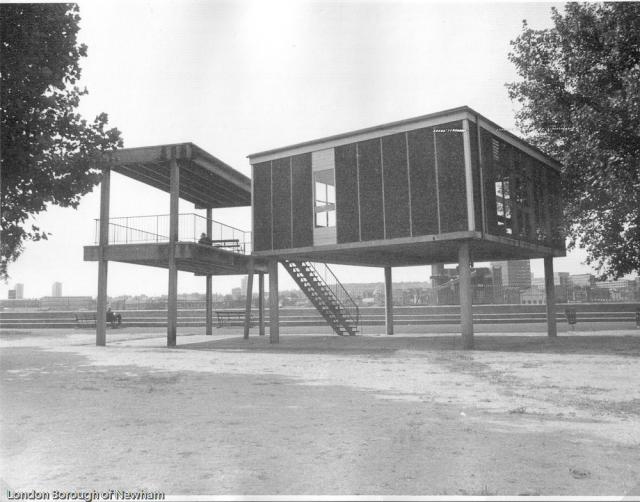
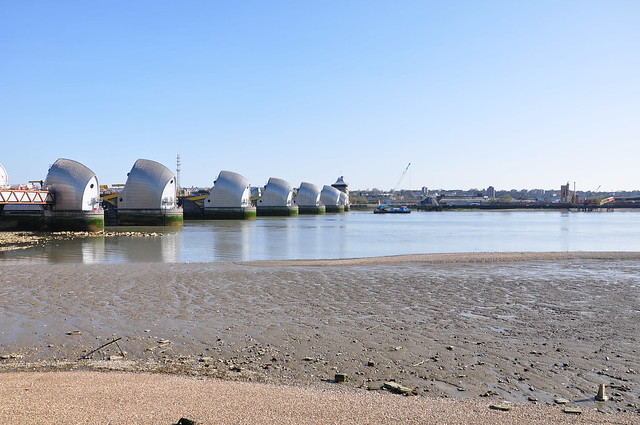
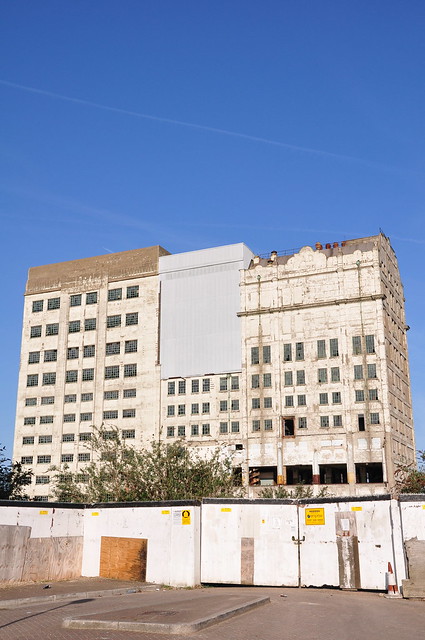
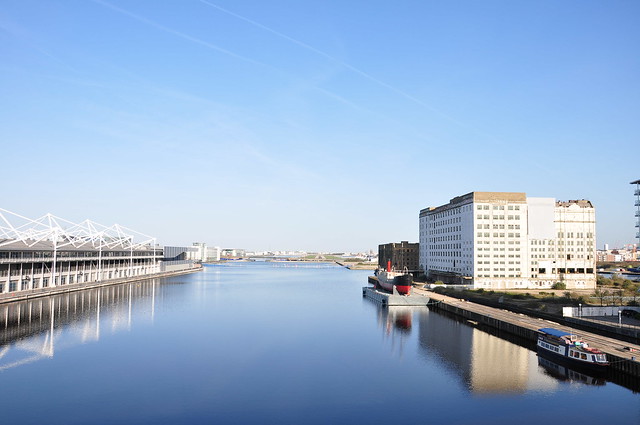
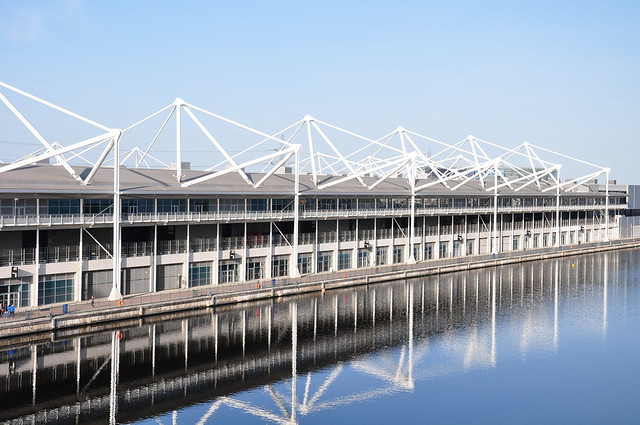
Sunday was such a lovely day we decided to go for on a little adventure way out in east London. I'd always wanted to have a snoop around the Millennium Mills building since I'd seen photos of the interiors on a few urban explorer sites - it looks absolutely incredible, if rather like a death trap, inside. I'd also recently seen an image of a fantastic viewing platform that used to stand in the Royal Victoria Gardens in the late 70s, and I'd never been to the gardens so I was curious to see what they were like so with mills and gardens in mind we headed out.

royal vic gardens viewing platform_1976

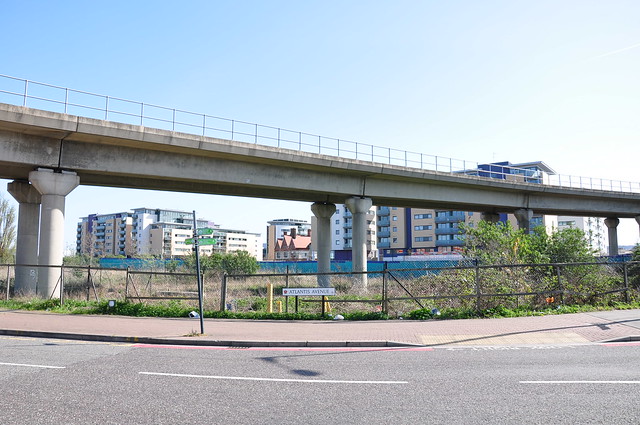
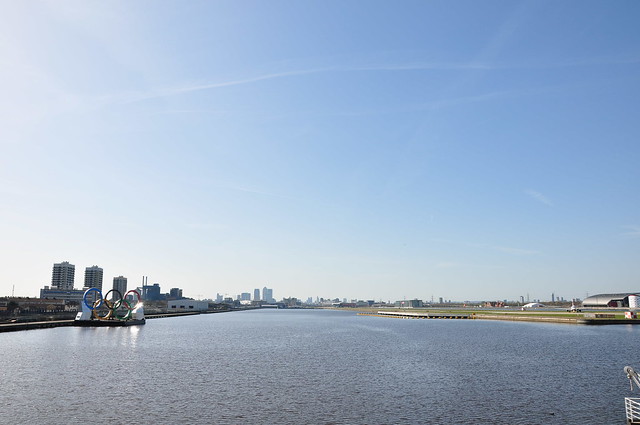
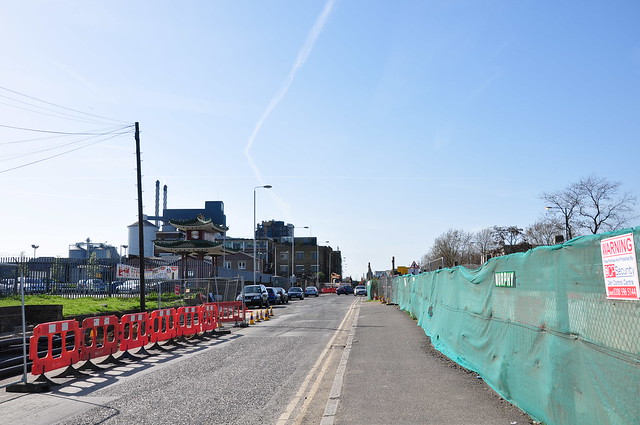
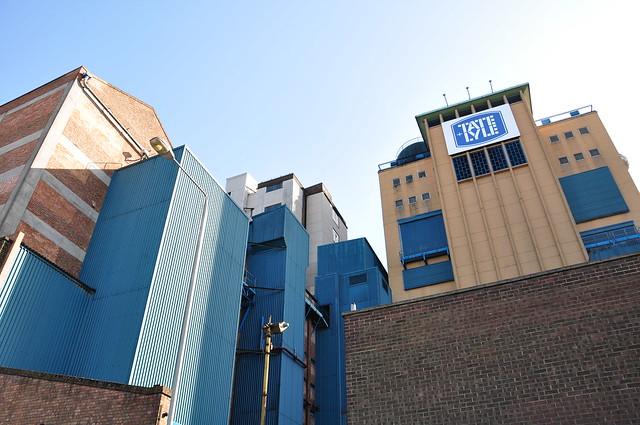
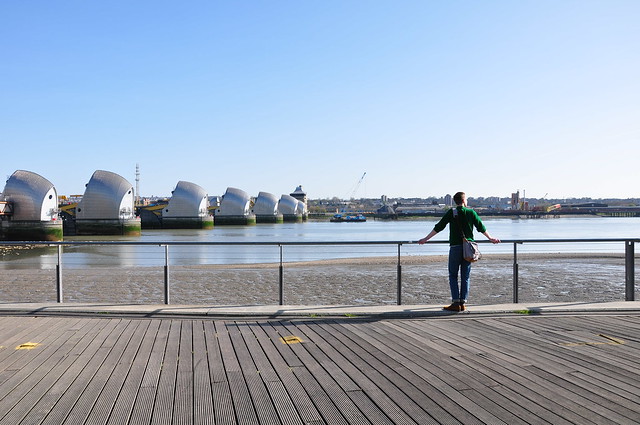
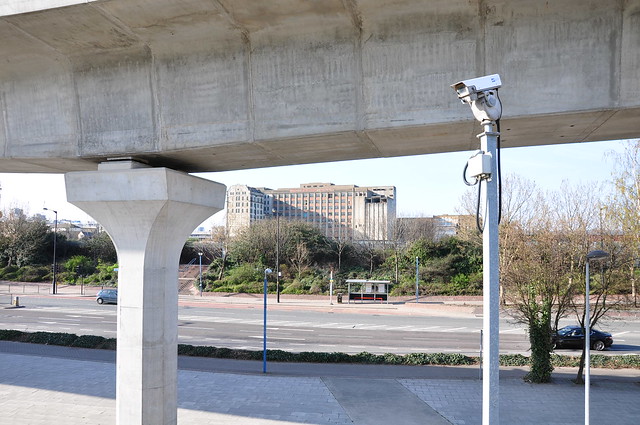
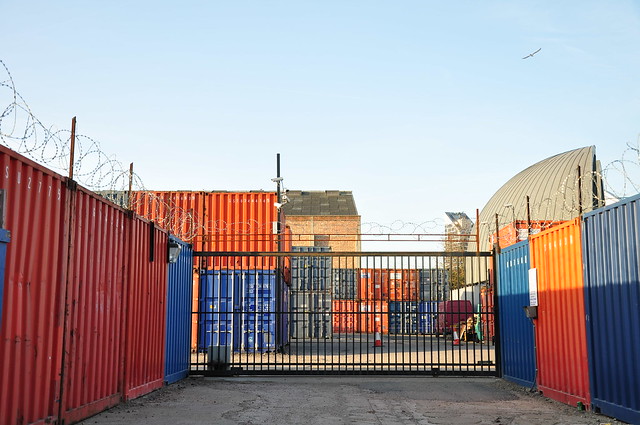
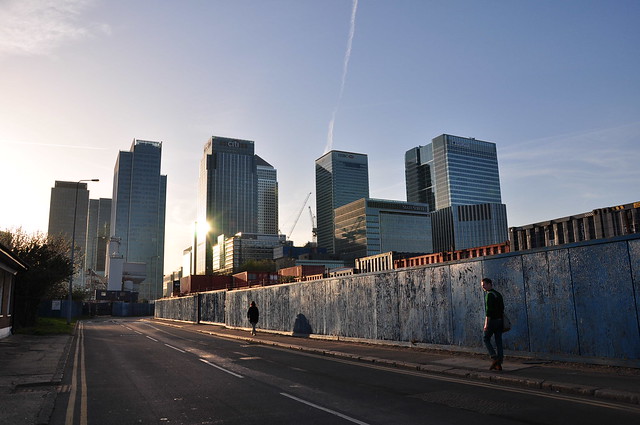
We walked from the far end of the docks past City Airport, through the Gardens, along the Thames as far as we could get before being spat back out to industrial wasteland. Past industrial carnage we were surprised to find an awesome Chinese cash and carry, though unsurprised to find brand new, grotesquely yuppie Barratt Homes blocks of thoughtless "investment" flats, sold on the back of being so near Pontoon Docks DLR and overlooking the Thames Barrier Park. We made it to the Millennium Mills at precisely the same time as a police car and so didn't get much further than the perimeter fence, sadly. More walking before a quick hop on the DLR to Blackwall for dinner, followed by a leisurely stroll into Canary Wharf.

DSC_0656
DSC_0666
DSC_0671
DSC_0674
DSC_0676
DSC_0679
DSC_0693
DSC_0694
DSC_0702
DSC_0726
DSC_0728
DSC_0743
DSC_0748
DSC_0751
DSC_0761
DSC_0762
DSC_0764
DSC_0768
DSC_0766

Thursday, 29 March 2012

Agora: Block336, Coldharbour, South London Gallery

Photobucket

"Institutions collapse from lack of funding, they do not die from lack of meaning. We die from lack of meaning." ~ G.B. Shaw via Dave Hickey

This Brixton trip was brought on by a tweet from Justin Hammond (@artcasual) about a new artist-run space opening up at 336 Brixton Road. Block336 is in the basement of an enormous Lambeth Council office building, set for rejuggification at some point in the near-distant future. It's a super cool space, despite a total lack of natural light, and a nice chat with co-founder Lucie Pardue gave me great hope that future programming will be interesting and varied. Their first show is called 1, which appeals to the no-nonsense-art-speak campaigner in me, though I don't think there are plans to title every subsequent exhibition sequentially. Since it's such an enormous space, they've been able to hang nearly sixty works without crowding. There's a room full of sculptural works by Andrew Hewish that I rather liked, and some lovely little paintings by Alex Virji that would have been more lovely had they not been on stupid canvas shapes.

Photobucket

Back on Brixton Road. Sun. Sun!  Glorious sun. More wandering, dithering, trying to decide whether to eat something at Brixton Village, but nothing appeals after a walk around, so carry on walking up Coldharbour Lane. Something about the sunshine makes everyone chatty. Or maybe it's just Brixton. One guy wants me to go back to his place; someone wants to give me directions; an old lady wants to know why I'm taking pictures of the hideous Fabrik apartment building on Coldharbour Lane; and a car pulls up next to me outside of Loughborough Junction station: a teenage girl wants to know where I bought my boots. In Italy. She looks unimpressed and drives off. I know how she feels. I've just been from Coldharbour London Gallery. Boring, boring, boring. Cowardly. The exhibition press text lettered onto the gallery wall is full of rubbish art speak which puts me in a foul mood and makes me less generous than I otherwise might have been. Why did the curator put the works of Keke and Kate together? Why did she give the exhibition such a stupid title: "The Inception of Line". What line? A Platonic Line? No, that's ridiculous. What does "The work of art exists within a trajectory or line, marking a point of communication between viewer and work that refuses to repeat itself." mean? I wish the curator would have at least had the courage to go with just one artist - Kate Terry - and fill the entire space with neon-coloured string. A sort of happy Chiharu Shiota. That would have been nice.

Photobucket

Photobucket

Thence to South London Gallery, which I'd especially been looking forward to given that I hadn't eaten any lunch and was ravenous. It was 4pm and the cafe wasn't serving any food until 6pm. What is this tyranny with prescribed meal times? It's like being on the continent. I'd come all the way there, so I thought I'd better at least have a look at the exhibitions before fainting of hunger. Alice Channer in the main gallery. No, no, no, no, no. Artists, please learn when to stop, when to say no, that's enough, this show doesn't need any more crap. The enormous drapery, printed with stretched images of classical statues, dripping like candle wax from the ceiling was quite appealing. Intriguing, even. But the mirrored stainless steel and marble pieces scattered all over the floor looked like something someone might buy in the housewares department of TK Maxx. I know the "dangers" of beauty in art, but I love it and long for it anyway. Not beauty exclusively, but political and cultural criticisms can still be delivered via a beautiful vehicle. I want more than anaesthesia offered by "the therapeutic institution". More than "mirrored stainless steel".

Photobucket

Luckily, I had a look in the first floor galleries before stumbling out to find food. It was a video piece called Inside. I heard song. Great. I hate video pieces, especially ones with contrived soundtracks. I sat down. I watched the video. I waited to feel the bile of dislike rise up, but it didn't. My mind whirred with all the delicious sensations of a struggle to decipher the stimulus. This is nuts, I thought. It looks fantastic, the narrative is mental, and I LOVE THE SONG! Edward Thomasson, you bloody brilliant person. Your video is awesome.

Wednesday, 28 March 2012

Dieppe, 21 September 1854

The world was not made for man. Man is the master of nature and is mastered by it. He is the only living creature who not only resists, but overcomes the laws of nature and extends his authority by energy and force of will. But to say that the universe was made for man is a very different matter. All man's constructions are as transitory as himself; time overthrows his buildings and blocks his canals, it reduces his knowledge to nothing and obliterates the very names of his nations. Where is Carthage now? Where is Nineveh? They say that each generation inherits from those that have gone before; if this were so there would be no limit to man's improvements or to his power of reaching perfection. But he is very far from receiving intact that storehouse of knowledge which the centuries have piled up before him; he may perfect some inventions, but in others, he lags behind the originators, and a great many inventions have been lost entirely. What he gains on the one hand, he loses on the other. I have no need to point out how harmful to morality, and even to health, many of his so-called improvements have been. Some, by removing or reducing the need for exertion and hard work, have diminished our patience to endure evils, and the energy that was given to us to overcome them. Others again, by increasing luxury and an appearance of wellbeing, have fatally affected the health of generations to come and have brought about a general decline in morals. We borrow from nature such poisons as tobacco and opium and make them the instruments of our gross pleasures, and we are punished by loss of energy and the degradation of our minds. Entire nations have been reduced to a form of slavery by immoderate use of stimulants and strong drink. No sooner do nations reach a certain stage of civilization than they find themselves growing weaker, especially in their standards of courage and morality. This general loss of energy, which is probably a result of the increase in pleasure and easy living, brings them to swift degeneration and to the neglect of the tradition that was their safeguard - their standard of national honour. In such circumstances it is hard for a nation to resist conquest. There will always be peoples ready to enrich their selves at the expense of degenerate nations, either because they are essentially barbarous, or because they still retain their courage and spirit of adventure. This easily foreseeable catastrophe sometimes turns out to be a source of new life to the conquered peoples. It purifies the air like a storm of a hurricane and brings fresh seed to an exhausted land. Sometimes a new civilization rises from the ruins, but centuries must pass before the arts of peace can flourish again. Those arts which in their turn are destined to lead to softer ways of living and the corruption of moral standards bring about once more the eternal succession of greatness and misery, proof of man's weakness, but also of the astounding power of his genius.


~ I have developed quite the soft spot for Eugene Delacroix since reading his Journal last year. I love this entry, where he borrows the Tacitean/Juvenalian argument that luxuries lead to civic corruption and remixes it with the Polybian view of the cyclical nature of governmental forms, all the while struggling between despair and admiration toward the capabilities of his fellow humanity. Wonderful.

Tuesday, 27 March 2012

So Far, the Future

Photobucket

Though So Far, the Future is probably the same size as a broom cupboard in the new Bermondsey White Cube, its aims are sizable indeed: to showcase the process and materials of design. It's always been something of a mystery to me that, given the size of London's design industry, there are so few dedicated design galleries in town. The best London-based design curators - Libby Sellers, DesignMarketo, and Faye Toogood - have always tended to exhibit in pop-up installations often coinciding with the London Design Festival. Before Sellers opened her new gallery space on Berners Street last year, I don't think it really occurred to anyone that collectors could be persuaded to buy design pieces as one-off or limited multiple editions from design galleries that weren't studios or showrooms. The LDF exhibitions were primarily directed towards press and manufacturers, just another part of the trade-show hoopla.

Perhaps the success of Sellers & co has inspired other young and would-be design curators to concoct more public-facing galleries. Or perhaps it's only now that a new generation of curators, who have been educated in a more interdisciplinary fashion, are realising that there may in fact be a market for design-technology-material hybrid gallery spaces after all. So Far, The Future, for example, was set up by Rebecca and Andreas Pohancenik: Andreas is creative director at Practice + Theory, which explains the gallery's apparent obsession with typography, and Rebecca has degrees in biology, philosophy of science as well as an MA from Kingston in curating contemporary design. The gallery's exhibition programme reflects the diversity of their backgrounds and feels largely driven by their educational and practical experiences. The exhibition I saw, Plastic Alchemy, didn't strike me as a complete success, but the ambition is certainly there and I look forward to seeing how the So Far, the Future programme develops. It's very exciting to see a dedicated design space set up by inquisitive and intelligent young curators who actually care about the process of design and in communicating that process to an audience wider than top-doller buyers.

Photobucket

Top photo copyright Duncan, bottom photo copyright So Far, the Future

Monday, 26 March 2012

Phoebe English

Photobucket

Last February in a tent in the courtyard of Somerset House, perched behind Daphne Guinness' bouffant, I tried to sustain interest as one hideously ugly confection after another marched out on model after model while the 'curated soundtrack' blasted out from corner speakers.

Suddenly, a swishy, twitchy black pony tail of a dress flicked past and my interest was piqued. I couldn't help but fixate on these Amazons strutting past in their man-killing, frenetically-fluid goddess dresses. I wanted a faux-hair and black rubber number of my own! I flicked through the 21 pages of student details in the Central St Martins MA fashion show catalogue to discover the person responsible for the apparitions before me: Phoebe English.

Photobucket

Photobucket

I tried getting in touch to see if I could buy one of her creations to wear as my wedding dress. Alas, she never replied. Probably for the best.

By that September, after winning an award at the February show, you could already see the giant paws of commercialism working their way into English's designs. No bad thing, everyone has to make a living, but the shift from materials to fabric didn't entirely seem to suit her. The hunter Amazons turned into gatherer Betty Rubbles drowning in smocked linen. Not sexy. Or wearable to anyone under 6ft5.

So it was a welcome relief to see less smocking and more body spring back in her A/W12 collection, even if some of the layers were almost Costa-esque in their simplicity. And the design mind that closes a show of all black with a pop of beautiful bubble-gum pink separates certainly warrants bookmarking. If you want to investigate for yourself, English is now stocked in Dover Street Market. Pretty impressive after only one season.

Photobucket

Photobucket

Photobucket

Photobucket

Photobucket

Photobucket

All photos © Phoebe English